Quick Answer: Live webinars are generally better for testing new offers, engaging directly with prospective clients and refining your presentation. Evergreen webinars are better suited to established offers, automated client acquisition and reducing the need for repeated live delivery.
For most coaches and consultants, I recommend starting with live webinars, validating the presentation and offer, and then transitioning to evergreen delivery once there is evidence that the webinar generates qualified opportunities.
However, neither format automatically delivers better conversion rates. Results depend on your audience, offer, presentation quality, traffic sources and follow-up process.
The key principle: Validate first. Automate second. Optimise continuously.
What You'll Learn
In this guide, you'll discover:
The differences between live and evergreen webinars
The advantages and disadvantages of each format
Which webinar format works best for different coaching and consulting offers
How to compare webinar conversion rates accurately
When to turn a live webinar into an evergreen webinar
How to combine live and automated webinars
Common mistakes that reduce webinar performance
My five-question framework for choosing the right approach
What Is the Difference Between Live and Evergreen Webinars?
A live webinar is an online presentation delivered in real time. An evergreen webinar is a pre-recorded presentation made available through an automated registration and viewing system.
Both formats can educate prospective clients, demonstrate your expertise and introduce your services. The main differences concern audience interaction, scheduling, presenter involvement and automation.
What Is a Live Webinar?
A live webinar takes place at a scheduled date and time, with the presenter delivering the content in real time.
Participants may be able to ask questions, respond to polls or interact directly with the presenter.
Live webinars are commonly used for:
Launching new coaching programmes
Introducing consulting services
Testing new offers and messaging
Running interactive workshops
Supporting cohort-based enrolment
Engaging audiences around timely subjects
Their main advantage is immediate feedback.
You can hear questions, address objections and adapt your explanation based on audience responses.
What Is an Evergreen Webinar?
An evergreen webinar is a pre-recorded presentation that prospective clients can access through an automated system.
The viewing experience may be available immediately, at scheduled times or through a combination of both.
An evergreen webinar funnel typically automates registration, confirmation emails, reminders, viewing access, follow-up and appointment booking.
Evergreen webinars are commonly used for:
Promoting established coaching programmes
Generating qualified consulting enquiries
Educating prospects before sales conversations
Serving audiences across different time zones
Reducing repeated presentation delivery
Supporting ongoing marketing campaigns
Their main advantage is consistency.
You can deliver a refined presentation repeatedly without having to present it live every time.
Live vs Evergreen Webinars: Side-by-Side Comparison
| Factor | Live Webinar | Evergreen Webinar |
|---|---|---|
| Delivery | Real-time presentation | Pre-recorded presentation |
| Audience interaction | Direct and immediate | Limited or asynchronous |
| Scheduling | Fixed dates and times | On-demand or automated sessions |
| Presenter involvement | Required for every session | Primarily during recording and updates |
| Testing new messaging | Easier to refine between sessions | Recording must be updated |
| Automation requirements | Moderate | Usually extensive |
| Scalability | Limited by presenter availability | Less dependent on presenter availability |
| Best suited for | New offers, launches and interactive education | Validated offers and ongoing lead generation |
| Main limitation | Repeated delivery and scheduling | Risk of automating an ineffective presentation |
My recommendation: Don't choose a webinar format based solely on convenience. Choose the format that matches your offer, audience and stage of business development.
When Should You Choose a Live Webinar?
Choose a live webinar when you need direct audience feedback, are introducing a new offer or want to create an interactive educational experience.
Live webinars are particularly valuable during the early stages of developing a webinar-based client acquisition strategy.
Here are four situations where I would generally favour live delivery.
1. You're Launching a New Coaching Programme
Imagine you're launching a leadership coaching programme for newly promoted executives.
You have a methodology, a target audience and an offer.
But you don't yet know which parts of your message will resonate most strongly.
A live webinar allows you to present your approach and observe how prospective clients respond.
You can identify:
Which examples create the strongest engagement
Which explanations cause confusion
What questions people ask
Which objections emerge
Whether your offer feels relevant and compelling
This information is incredibly valuable.
Instead of guessing what your audience needs, you can use real feedback to improve your presentation.
2. Your Programme Has Fixed Enrolment Dates
Live webinars work well for coaching programmes, training courses and consulting workshops with defined starting dates.
For example:
Tuesday: Deliver the webinar
Wednesday: Open applications
Thursday and Friday: Conduct consultations
Friday: Close enrolment
Monday: Begin the programme
This creates a natural connection between the webinar and the enrolment process.
The deadline is meaningful because the programme genuinely has a scheduled start.
You don't need artificial urgency.
3. Your Offer Requires Direct Interaction
Some consulting engagements involve complex problems, multiple stakeholders or highly specific requirements.
Prospective clients may want to ask questions before deciding whether your approach is relevant to their organisation.
A live webinar allows you to address those questions immediately.
For high-value consulting services, a smaller interactive webinar may generate better-qualified conversations than a large presentation with limited engagement.
4. You're Still Developing Your Message
A webinar is more than a presentation.
It's an opportunity to discover how prospective clients understand the problem you solve.
When you deliver live, you can refine your positioning, examples, explanations and offer based on audience responses.
That learning process can help you develop a stronger presentation before committing to automation.
The Disadvantages of Live Webinars
Live webinars also have limitations.
They require preparation and presenter availability.
Attendance can be affected by scheduling conflicts and time zones.
Technical problems can disrupt the experience.
And repeated delivery can become time-consuming.
I experienced the technical risks firsthand during my very first webinar.
Almost 400 people registered through paid advertising.
Five minutes into the presentation, my internet connection dropped.
I lost most of the audience.
After reconnecting, I continued with the small number of participants who remained.
Despite the disruption, four people purchased my $497 programme.
It wasn't a perfect webinar by any stretch of the imagination.
But it demonstrated something important.
When your message resonates and your offer addresses a genuine need, even an imperfect presentation can generate buying interest.
That experience also taught me how important it is to have reliable technology and processes supporting the presentation.
When Should You Choose an Evergreen Webinar?
Choose an evergreen webinar when you have a validated presentation and offer, want to serve prospective clients more consistently and are ready to automate your client acquisition process.
Evergreen webinars can be particularly effective for coaches and consultants who have established services and a repeatable sales process.
1. Your Offer Is Already Proven
Suppose you're a business consultant with an established advisory programme.
You know your ideal clients.
You understand their challenges.
You've refined your presentation.
And you have evidence that the webinar generates qualified enquiries or sales.
At this stage, automating the presentation may make sense.
Rather than delivering the same material repeatedly, you can make it available through an evergreen webinar funnel.
2. You Serve Clients Across Different Time Zones
If you're attracting prospective clients from Dubai, London, New York and Sydney, finding one convenient live webinar time can be difficult.
An evergreen webinar can offer more flexible viewing opportunities.
However, convenience doesn't automatically lead to attendance.
You still need effective reminders, relevant messaging and an engaging presentation.
3. You Want a More Consistent Lead Generation Process
An evergreen webinar can connect multiple marketing channels to one repeatable client acquisition process.
For example:
Paid Advertising or Organic Traffic → Registration → Automated Reminders → Webinar → Application → Sales Conversation → Follow-Up
Each stage can be tracked and improved.
This allows you to identify whether prospective clients are registering, attending, engaging, booking conversations and becoming clients.
For more detail, read my Complete Guide to Webinar Funnels.
4. You Want to Reduce Repeated Presentation Delivery
If you deliver the same educational presentation several times every month, recording a validated version can free up valuable time.
You can spend more time working with clients, improving your offer and conducting qualified sales conversations.
But remember:
An evergreen webinar is not a passive-income machine.
It still requires traffic, monitoring, technical maintenance, content updates and optimisation.
The Disadvantages of Evergreen Webinars
Evergreen webinars can become ineffective when businesses automate too early.
A recorded presentation cannot adapt spontaneously to audience questions.
Outdated content may undermine credibility.
Technical problems can affect multiple viewers.
And an ineffective offer won't become compelling simply because the presentation is automated.
Automation amplifies the system you already have. It doesn't fix a weak strategy.
Which Converts Better: Live or Evergreen Webinars?
Neither live nor evergreen webinars consistently achieve higher conversion rates across every business. Live webinars may benefit from stronger interaction, while evergreen webinars can provide more viewing opportunities and greater operational efficiency.
The better-performing format depends on your audience, offer, traffic quality, presentation and follow-up.
To make a meaningful comparison, you need to measure the entire client acquisition process.
Example: Comparing Two Webinar Campaigns
Consider these hypothetical results.
| Metric | Live Webinar | Evergreen Webinar |
|---|---|---|
| Registrations | 200 | 400 |
| Webinar viewers | 100 | 160 |
| Viewing rate | 50% | 40% |
| Booked calls | 12 | 16 |
| Booking rate from viewers | 12% | 10% |
| New clients | 3 | 4 |
| Registration-to-client rate | 1.5% | 1% |
These figures are illustrative examples, not actual client results or industry benchmarks.
The evergreen webinar generates more clients overall.
However, the live webinar converts a higher percentage of registrations into clients.
Which campaign is better?
We cannot answer that without knowing the acquisition costs, delivery expenses, sales effort and client profitability.
An evergreen webinar that generates four clients at a very high acquisition cost may be less profitable than a live webinar that generates three clients more efficiently.
The Webinar Metrics That Actually Matter
I recommend tracking these seven metrics.
1. Registration Conversion Rate
The percentage of landing page visitors who register.
2. Webinar Viewing Rate
The percentage of registrants who actually watch the webinar.
3. Engagement and Watch Time
How much of the presentation viewers consume and where they stop watching.
4. Application or Booking Rate
The percentage of viewers who take the next step.
5. Sales Call Attendance Rate
The percentage of booked prospects who attend their consultation.
6. Client Conversion Rate
The percentage of qualified prospects who become paying clients.
7. Customer Acquisition Cost
The total relevant acquisition expenditure divided by the number of clients acquired.
For higher-value coaching and consulting offers, I pay particular attention to the quality of the applications and conversations generated.
A smaller number of highly qualified prospects can be more valuable than hundreds of registrations from people who aren't suitable for your services.
My Recommended Five-Step Webinar Strategy
For most coaches and consultants, I recommend developing the webinar live, validating the offer and sales process, and only then building the evergreen system.
Here's how I would approach it.
Step 1: Define Your Audience, Problem and Offer
Before choosing a webinar platform, get clear about three things:
Who is the webinar for?
What specific problem does it address?
What action should the right prospect take afterwards?
For example, a business coach might create a webinar for established consultants who struggle to generate a consistent flow of qualified enquiries.
The webinar could explain the underlying reasons their current marketing isn't producing predictable opportunities and introduce a framework for improving their acquisition process.
The next step might be an application for a strategy consultation.
Everything should connect logically.
Step 2: Develop and Deliver the Webinar Live
Build a presentation that demonstrates your expertise without overwhelming the audience.
Focus on one clearly defined problem and a practical framework for addressing it.
Deliver the webinar live to a relevant audience.
Observe how people respond.
Pay attention to the questions they ask and the actions they take afterwards.
Step 3: Refine the Presentation and Offer
Review your results.
Where did people lose interest?
Which examples resonated?
Did the call to action feel natural?
Were the people booking consultations actually suitable for your offer?
Improve the presentation and repeat the process.
You're looking for evidence that your message, audience and offer work together.
Step 4: Build the Evergreen Funnel
Once the presentation has demonstrated commercial potential, create the evergreen version.
Your system may include:
Registration landing page
Webinar hosting platform
Confirmation emails
Reminder emails and messages
Webinar viewing page
Application or booking page
CRM integration
Post-webinar follow-up
Conversion tracking
Make sure the entire experience works before investing heavily in traffic.
Step 5: Monitor and Optimise
Review performance regularly.
Identify where people drop out of the process.
Test improvements to the registration page, reminders, presentation, offer and follow-up.
Keep the content accurate and relevant.
An evergreen webinar should be treated as an evolving business asset, not a recording you create once and forget.
Should Coaches and Consultants Use Different Webinar Formats?
Coaches and consultants can use either format, but the right choice often depends on the complexity of the offer, the buying process and whether enrolment is continuous or time-sensitive.
Webinar Strategy for Coaches
For coaches selling ongoing one-to-one programmes, an evergreen webinar can help prospective clients understand the methodology before applying for a consultation.
For coaches launching group programmes with fixed enrolment dates, live webinars may provide a better fit.
For example:
A leadership coach selling a six-month private programme might use an evergreen webinar to attract qualified applicants throughout the year.
A career coach launching an eight-week group programme might use a live webinar to support each enrolment period.
Learn more in our guide to Webinar Funnels for Coaches.
Webinar Strategy for Consultants
Consultants may have longer and more complex sales processes.
An evergreen webinar can educate prospects about a repeatable service and prepare them for an initial conversation.
A live webinar may be preferable when discussing complex organisational challenges, new regulations or industry-specific developments.
For example:
A marketing consultant offering a standardised acquisition system might use an evergreen webinar.
A cybersecurity consultant explaining a newly introduced compliance requirement might choose a live webinar that allows for immediate questions.
Explore our guide to Webinar Funnels for Consultants.
Can You Combine Live and Evergreen Webinars?
Yes. A hybrid webinar strategy combines automated educational content with selected live interactions, such as Q&A sessions, workshops or periodic launches.
For example, you could:
Use an evergreen webinar for initial education.
Invite interested viewers to a monthly live Q&A session.
Run quarterly live webinars when introducing new offers.
Use recordings between live events to maintain consistent lead generation.
This approach offers flexibility.
However, it also adds complexity.
If you're building your first webinar funnel, I recommend making one delivery model work before introducing additional components.
Five Common Webinar Strategy Mistakes
Mistake 1: Automating Before Validating
The problem: You record a webinar and invest in automation before knowing whether the message or offer works.
The solution: Test the presentation with a relevant audience and refine it based on real engagement and commercial outcomes.
Mistake 2: Choosing Live Webinars Only to Create Urgency
The problem: You assume that a scheduled event will automatically encourage people to buy.
The solution: Build urgency around genuine circumstances, such as limited programme capacity or actual enrolment deadlines.
Mistake 3: Assuming Evergreen Means Passive Income
The problem: You expect automation to generate clients without ongoing attention.
The solution: Monitor performance, maintain the technology, update the presentation and optimise follow-up.
Mistake 4: Ignoring the Viewer Experience
The problem: You focus on webinar software and automation while neglecting the quality of the presentation.
The solution: Make the webinar relevant, engaging and easy to follow, regardless of delivery format.
Mistake 5: Measuring Registrations Instead of Business Outcomes
The problem: You celebrate registration numbers without examining the quality of prospects or the revenue generated.
The solution: Track the complete journey from registration to qualified enquiry, sales conversation and client acquisition.
Troubleshooting: What If Your Webinar Isn't Converting?
Before changing from live to evergreen or vice versa, identify where the funnel is underperforming.
Here are six common symptoms and what I would investigate.
Problem 1: Few People Register
Possible cause: Weak positioning or irrelevant traffic.
What to check: Your audience targeting, landing page headline and the relevance of the webinar topic.
Problem 2: Registrants Don't Watch
Possible cause: Scheduling friction, weak reminders or insufficient motivation to attend.
What to check: Your registration-to-viewing experience, reminder sequence and available viewing times.
Problem 3: Viewers Leave Early
Possible cause: A slow introduction, unclear relevance or a presentation that doesn't meet expectations.
What to check: The first five to ten minutes, audience retention data and the connection between your registration promise and the webinar content.
Problem 4: Viewers Don't Apply or Book Calls
Possible cause: An unclear next step, an unconvincing offer or a disconnect between the educational content and your service.
What to check: Your call to action, offer positioning and application process.
Problem 5: You Get Calls but Few Clients
Possible cause: Poor prospect fit, unclear expectations or problems in the sales process.
What to check: Lead qualification, offer relevance and what happens during the consultation.
Problem 6: Customer Acquisition Costs Are Too High
Possible cause: Expensive traffic, weak conversion rates or inefficiencies across multiple funnel stages.
What to check: Traffic costs, registration rates, viewing rates, booking rates and client conversion.
The most important point is to diagnose the problem before making major changes.
A low registration rate isn't necessarily a webinar presentation problem.
A high registration rate with poor client conversion may indicate an audience or offer problem.
And a technically perfect evergreen funnel can still perform badly if the underlying message doesn't resonate.
How Long Does It Take to Build a Successful Webinar Funnel?
There is no universal timeframe. The development period depends on the complexity of your offer, your existing audience, the quality of your presentation and how much testing is required.
A business with an established offer and a proven presentation may be able to move towards evergreen delivery relatively quickly.
A business developing a new offer may need several rounds of live testing and refinement.
I would avoid setting an arbitrary deadline for automation.
Instead, look for evidence that the presentation consistently generates the kind of opportunities your business needs.
What Results Should You Expect?
A successful webinar strategy should help you develop a clearer message, educate prospective clients and create a more structured path towards enquiries or sales.
Over time, a well-designed evergreen system may reduce repeated delivery work and make the acquisition process easier to measure.
However, results will vary.
There is no guaranteed number of registrations, appointments or clients.
The performance of your webinar depends on the relevance of the audience, the strength of the offer, traffic quality, sales execution and ongoing optimisation.
Final Thoughts: Which Webinar Format Should You Choose?
Choose live webinars when you need to learn from your audience, validate an offer or create meaningful real-time interaction. Choose evergreen webinars when you have a proven presentation and want a more consistent, automated client acquisition process.
For most coaches and consultants, I believe the strongest starting point is live validation followed by selective automation.
But remember:
The webinar format is only one part of the equation. Your message, offer, audience and follow-up process have a much greater influence on whether your webinar generates clients.
Focus on those fundamentals first.
Then build the delivery system that supports your business goals.
Ready to Build Your Webinar Client Acquisition System?
If you want to develop a webinar strategy around your expertise and learn how to turn your message into qualified client conversations, explore the Influential Voice Accelerator.
If you already have an established offer and would prefer the technical implementation handled professionally, learn more about our Done-For-You Webinar Funnels.
About the Author
Lisa Hugo is a communication and webinar strategy specialist with more than two decades of experience helping executives, entrepreneurs and experts communicate with clarity and impact.
As co-founder of Audacia Marketing Management LLC, Lisa combines communication expertise with practical webinar marketing and client acquisition strategies for coaches, consultants and expertise-based businesses.
Frequently Asked Questions
Are evergreen webinars less effective than live webinars?
Not necessarily. Evergreen webinars can perform well when the presentation, offer and follow-up are effective. Live webinars may provide stronger direct interaction. Neither format is universally more effective.
Can evergreen webinars sell high-ticket coaching programmes?
Yes. For higher-value coaching programmes, an evergreen webinar often leads to an application or consultation rather than an immediate purchase. The presentation helps prospects understand the approach and decide whether to explore working together.
How long should a live webinar be?
There is no ideal duration for every audience. The webinar should be long enough to explain the problem, demonstrate the framework and introduce the next step without unnecessary content.
How long should an evergreen webinar be?
The same principle applies. Evergreen webinars should be engaging and focused. Use viewer engagement data to identify sections that need improvement rather than following an arbitrary duration.
Can I turn a live webinar into an evergreen webinar?
Yes. A successful live presentation can become the foundation of an evergreen webinar. You may need to edit or re-record sections that reference past dates, live interactions or outdated offers.
Should evergreen webinars pretend to be live?
No. I recommend being transparent about recorded presentations. You can create an engaging automated experience without misleading viewers about whether the presenter is speaking in real time.
Do I need paid advertising for an evergreen webinar?
No. Evergreen webinars can attract visitors through organic search, email marketing, social media, partnerships and paid advertising. The right traffic strategy depends on your audience and business economics.
Are live webinars better for launching new offers?
Often, yes. Live delivery provides opportunities to test messaging, gather feedback and address questions immediately. This makes it particularly useful when introducing an offer that hasn't yet been validated.
Can I use both live and evergreen webinars in the same business?
Yes. Many businesses can benefit from combining evergreen educational presentations with occasional live workshops, Q&A sessions or launches. The key is to avoid unnecessary complexity.
Looking for Lisa's executive communication coaching, public speaking training or corporate programmes?


Helping coaches, consultants and experts turn their expertise into clients through webinars, strategic communication and smart marketing systems.
WEBINAR MARKETING
PROGRAMS
LISA HUGO
Copyright © 2026 Audacia Marketing Management LLC, All rights reserved.
Privacy Policy : Terms of Use : Cookie Policy : Refund Policy



She’s helped 1000s of clients around the world to develop their speaking skill with her 1 : 1 coaching and powerful programs, each centered on a different aspect of speaking, including confidence, voice, presentation, and body language.
COMPANY
LEGAL
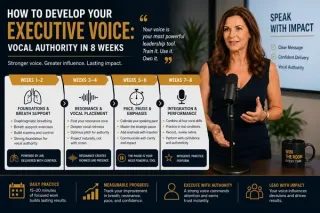
How to Develop Your Executive Voice: Vocal Authority in 8 Weeks
Develop your executive voice with this 8-week vocal authority program. Learn breath support, resonance, pace, pause, and practice routines for senior leaders. ...more
Improve Public Speaking Skills: Expert Tips by Lisa Hugo ,Corporate Communication Tips for CxOs & Executives
July 14, 2026•7 min read